Developments for Integrated Schottky Receivers in the Terahertz Regime
Water is simultaneously one of the most important and one of the most difficult molecules to detect in deep space. Mapping water gives untold information on where and how star-forming regions appear in younger galaxies. However, the Earth’s atmosphere is comprised of so much water that detecting any from the ground is impossible. Therefore, water detection must be done by satellite, and with satellites, size is everything. I was tasked with miniaturizing a high-performance integrated mixer/receiver for the next generation of deep-space CubeSats, with the goal was to detect the specific water vapor spectral lines at 556 GHz and 1.2 THz that trace star formation in molecular clouds.
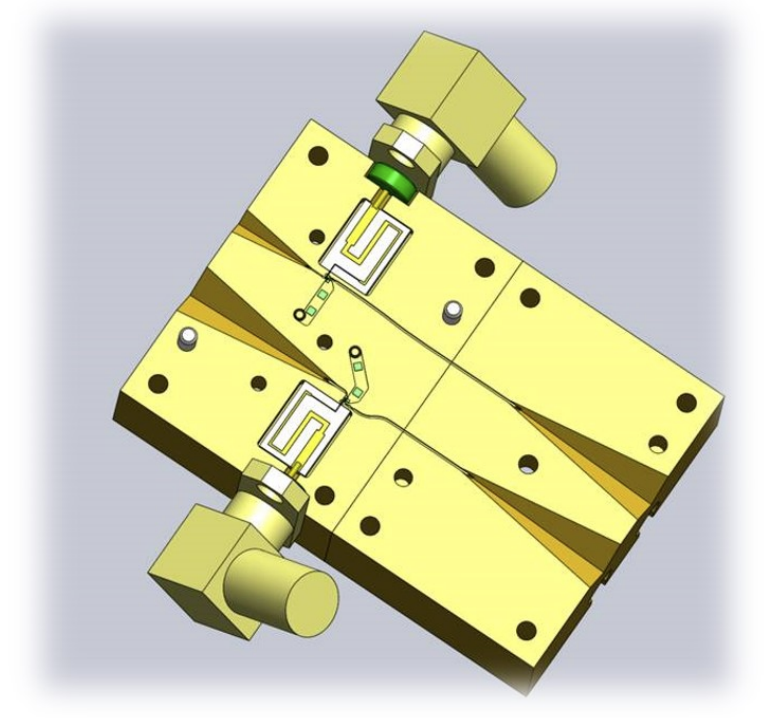
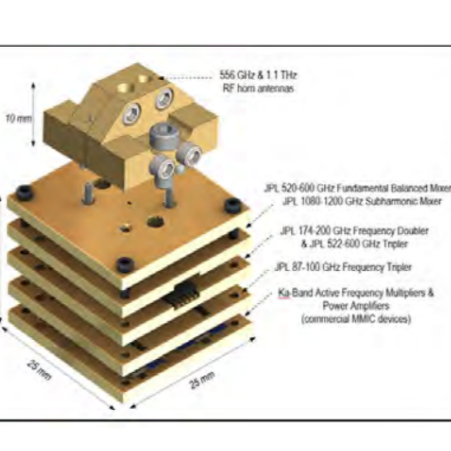
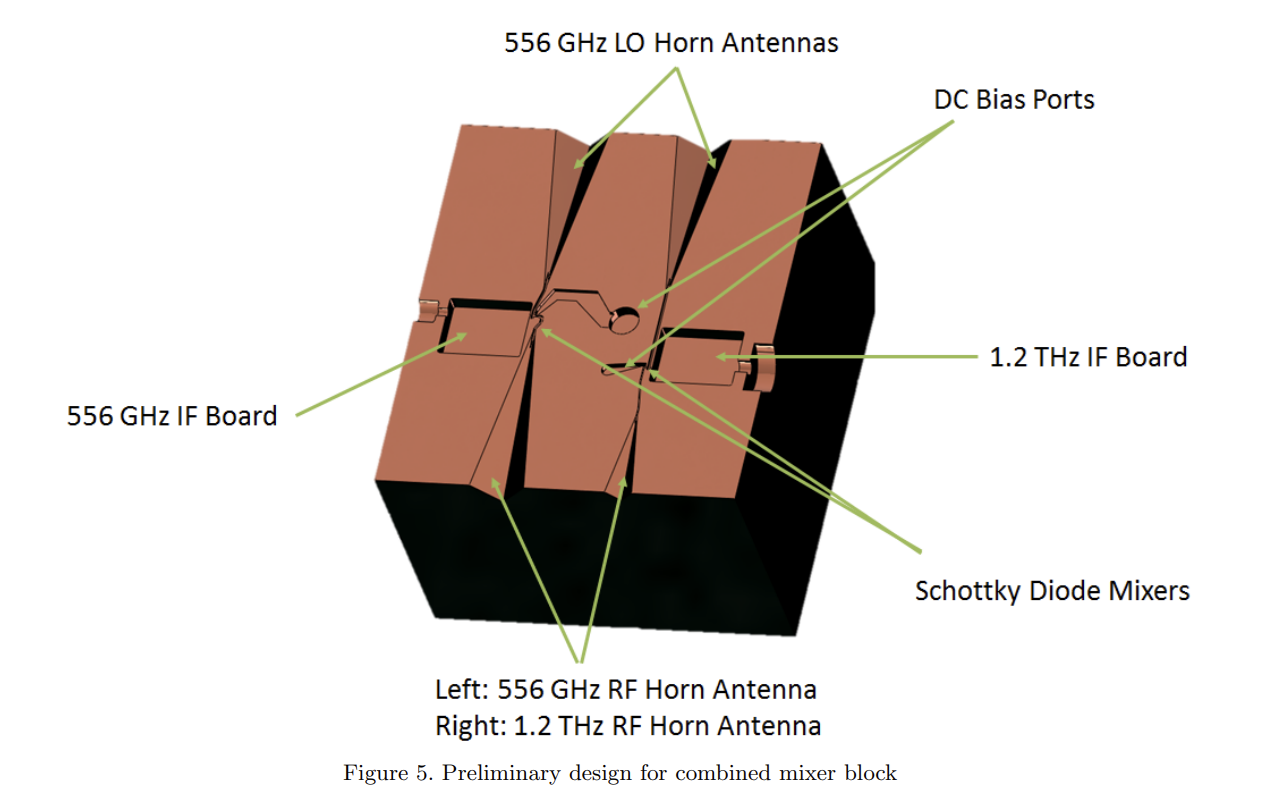
To solve this, I co-developed a radically integrated, dual-band Schottky diode receiver that compressed two separate JPL instruments into a single, compact block. Instead of the traditional "cascaded" waveguide design that chains components in a long line, I utilized novel multi-layer monolithic circuits to stack the architecture vertically into a 3D "cube." I also engineered a shared Local Oscillator (LO) path that could drive both mixer bands simultaneously, cutting the power requirement in half.
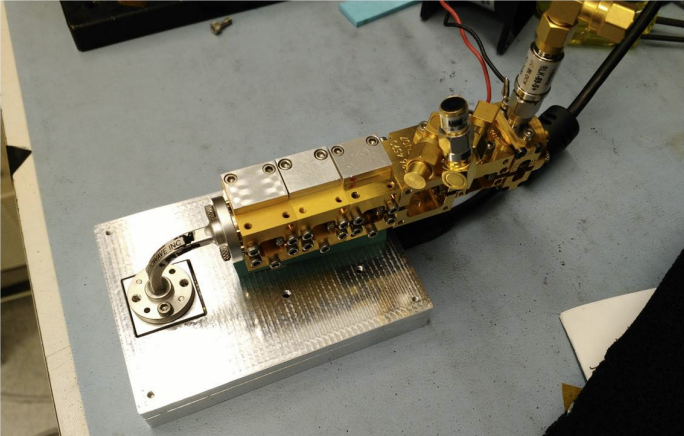
Validating this design meant pushing the limits of terahertz metrology. I performed comprehensive noise temperature characterization and power consumption analysis, proving that the integrated unit didn't just meet the spec—it set a new one. We achieved world-record noise performance at 556 GHz while keeping the total system power under 8 Watts and reducing the volume by an order of magnitude.
This project was my introduction to shrinking "big science" capabilities into small-form-factor packages. By rethinking the physical architecture of the receiver, I helped prove that low-cost CubeSat constellations could one day achieve the spatial resolution of billion-dollar flagship missions.